MetaMask Co-founder Departs, Leaving Behind a Little Fox Packaged in an IPO Prospectus

marsbitPublished on 2026-04-23Last updated on 2026-04-23

Abstract

MetaMask co-founder Dan Finlay has left Consensys after a decade, citing burnout and a desire to spend more time with family. MetaMask, launched in 2016, is one of the most recognizable crypto wallets with over 100 million installs and 30 million monthly active users. Despite its dominant position, the wallet faces growing competition from newer entrants like Phantom, which has expanded beyond Solana and reportedly generates more than double MetaMask’s annual revenue. The timing of Finlay’s departure coincides with Consensys’s plans for an IPO, advised by J.P. Morgan and Goldman Sachs. The company, last valued at $7 billion in 2022, has undergone multiple rounds of layoffs amid slowing growth and internal challenges. Employee reviews on Glassdoor point to low morale and management issues. MetaMask’s delayed expansion into chains like Solana and the long-promised but unreleased $MASK token have also drawn criticism. While the wallet remains the default option for many Ethereum dApps, its product-market fit is weakening as new users increasingly choose alternatives. Consensys appears to be prioritizing monetizing MetaMask’s strong brand recognition through a public listing while its market position is still valuable. Finlay’s quiet exit reflects both personal fatigue and broader shifts in the competitive landscape of crypto wallets.

Author: Curry, Deep Tide TechFlow

The person who built this little fox doesn't want to build anymore.

On April 23, MetaMask co-founder Dan Finlay officially announced his departure from Consensys, ending a decade-long development career. The reason given was professional burnout and a desire to spend more time with family.

MetaMask is perhaps the most recognizable product application in the crypto world. That little orange fox logo is known to almost everyone who has ever installed a crypto wallet. In 2016, Finlay and another co-founder, Aaron Davis, created this browser plugin within Consensys, allowing ordinary people to interact with Ethereum without running a full node.
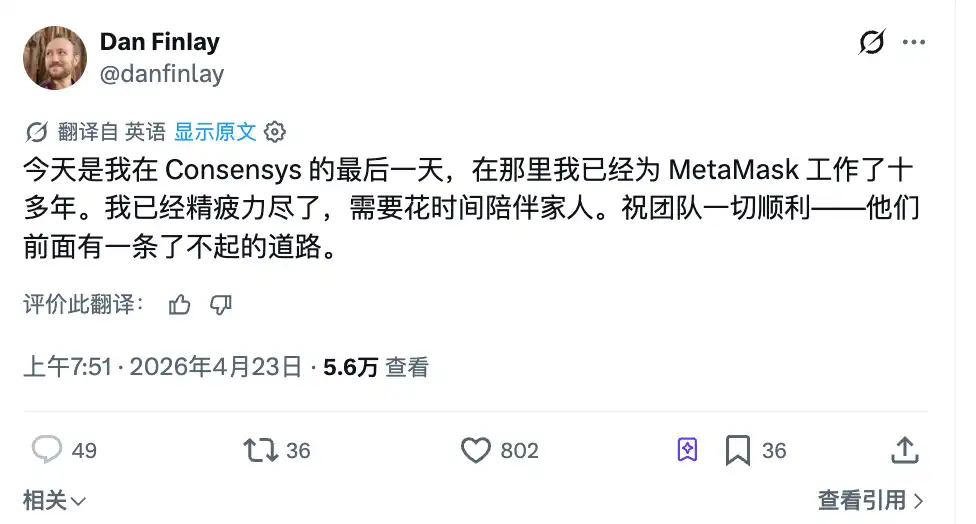
Over the past ten years, according to statistics from multiple third-party platforms, it has achieved over 100 million global installs, with approximately 30 million monthly active users. Its swap function has cumulatively generated over $325 million in fee revenue.

A look at public information reveals that Finlay has hardly given any interviews in the past decade. Previously a coder at Apple, he is fundamentally an engineer at heart, not someone who builds a public persona.

When such a person says they are tired, they usually mean it. It's just that the timing of his departure is hard not to overthink.

Just a few months ago, Consensys hired J.P. Morgan and Goldman Sachs as IPO advisors, with a target to go public as soon as this year, according to an Axios report.

The company's last funding round was in 2022, when it was valued at $7 billion. It has since undergone at least two rounds of layoffs. And the $MASK token, promised since 2021, still hasn't materialized after five years.

Issuing a token doesn't seem that necessary for a wallet. More frighteningly, it seems like the little fox isn't that necessary for everyone either.

The Default, But Not the Preferred Choice

In the past, the first step in many dApp development documents was "Please install MetaMask first." It was the default wallet for the industry, like the blue IE browser on your Windows desktop ten years ago.

The problem is, the default and the preferred choice have long ceased to be the same thing.

Phantom started out only as a Solana wallet, later expanding to Ethereum and Bitcoin. In January 2025, it raised a $150 million Series C, valuing the company at $3 billion.

According to estimates by whales.market based on on-chain data, Phantom's annualized revenue is approximately $108 million;相比之下 MetaMask's is about $46 million. More than double the difference, and Phantom is five years younger than MetaMask.

Phantom started on Solana in 2021, catching the entire process of the Solana ecosystem's recovery and explosion. According to Helius statistics, Solana's DEX trading volume surpassed Ethereum's in 2024, and on-chain application revenue reached $2.39 billion in 2025, a 46% year-on-year increase. 725 million new wallets conducted their first Solana transaction in 2025. Phantom was waiting at the door when these users came in.
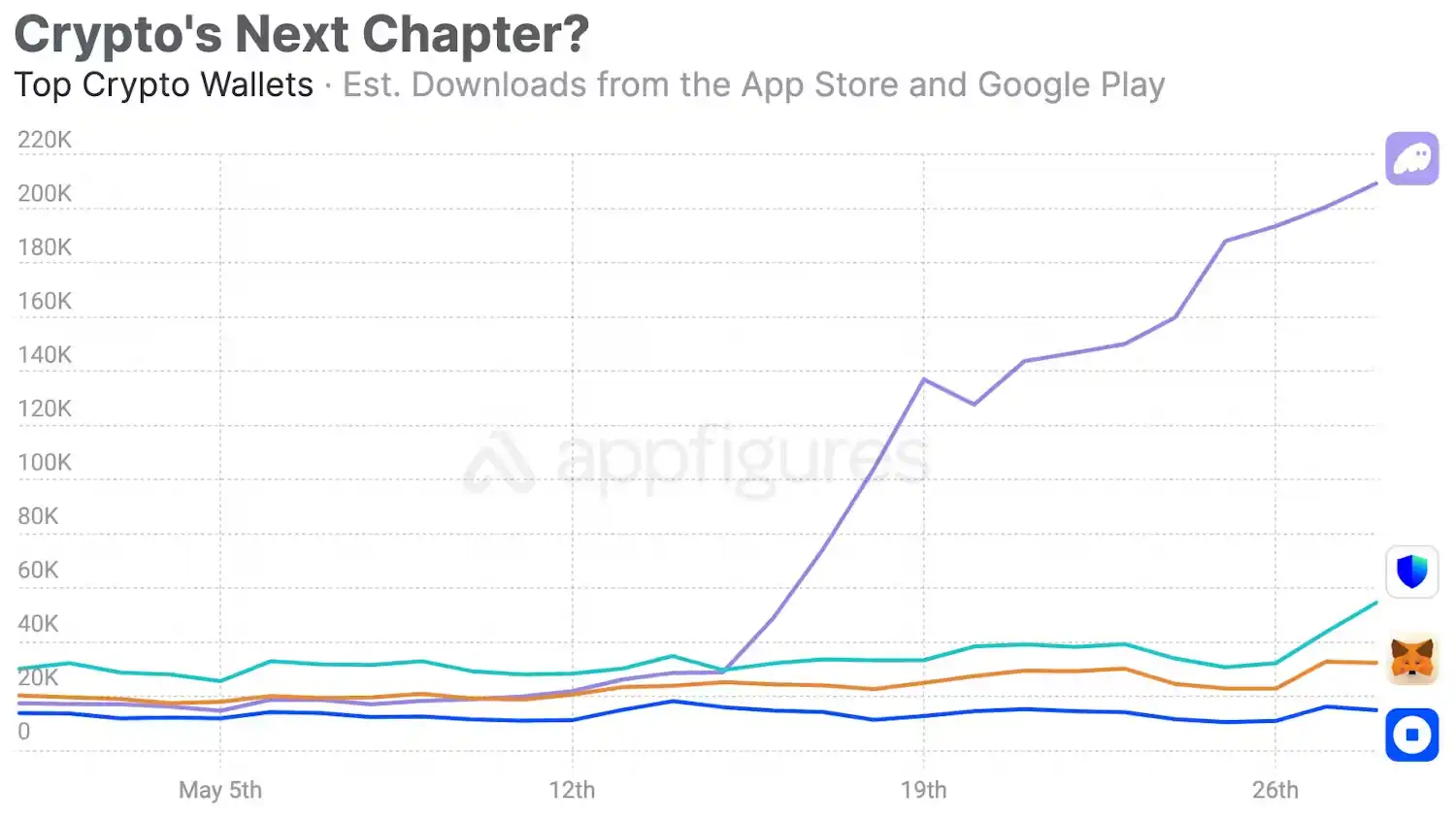
And MetaMask? It only launched native Solana support in May 2025. Before that, users who wanted to access Solana through MetaMask had to install a third-party plugin called Snaps, an experience akin to installing a Chrome kernel on the IE browser...

In these five years, Solana went from a chain that nearly died due to the FTX crash to, at one point, the chain with the largest trading volume. Phantom's valuation rose accordingly, securing a $150 million Series C funding round in early 2025 with a $3 billion valuation.

The author believes MetaMask's slowness wasn't due to technical inability, but also an issue of identity. MetaMask is Ethereum's favored child; its parent company Consensys was founded by Ethereum co-founder Joe Lubin.

Supporting Solana was an expansion for Phantom, but a betrayal for MetaMask. By the time the Ethereum ecosystem's growth indeed slowed down and cross-chain became necessary, the window of opportunity had long passed.

Of course, MetaMask's compatibility within the Ethereum ecosystem is still the strongest. Almost all dApps on EVM chains test it as the default option. The 30 million monthly active users are real.

But this stickiness doesn't come from product strength; it comes from switching costs. And switching costs can only prevent old users from leaving, not stop new users from going elsewhere.

A person who started playing on-chain in 2025 is probably not being recommended MetaMask by their friends when they go to install a wallet.

The Little Fox Up for Sale

The product is falling behind, people are leaving, but Consensys is pursuing an IPO.

According to an Axios report in October 2025, Consensys hired J.P. Morgan and Goldman Sachs as IPO advisors, targeting a public listing as soon as this year. If successful, this would be the first company deeply tied to Ethereum core infrastructure to list on the US stock market.

But in the same year it hired the investment banks, Consensys underwent at least two rounds of layoffs.

In October 2024, it cut 20% of its staff, about 160 people, with CEO Joe Lubin citing macroeconomic pressures and regulatory uncertainty. Another round occurred mid-2025, this time justified as "driving profitability."

On the well-known job review community Glassdoor, employee reviews are uglier than the layoffs themselves.

Someone wrote that the company lays off people at least twice a year, always cutting frontline contributors, never management. Another said that after sharing their promotion aspirations with their superior, their name appeared on the next layoff list.

It's unclear how much of these reviews are emotion and how much is fact. But a company conducting significant layoffs while employee morale hits rock bottom, all while sprinting towards an IPO, is itself a signal.

Then there's the story of the MASK token.

In 2021, Lubin tweeted "Wen $MASK?", causing a stir in the community. In 2022, he further explained plans for a token and DAO to promote "progressive decentralization." In May 2025, Finlay was interviewed by The Block and asked when the token would come; his answer became maybe.

For users, the MASK token is a carrot, dangled to keep using, interacting, and contributing on-chain data to MetaMask. For Consensys, the token is a card not yet played before the IPO.

Issuing it too early dilutes the valuation narrative; issuing it too late loses community support. Now the co-founder has left, the token hasn't been issued, but the IPO is coming.

MetaMask's product competitiveness is declining, a trend difficult to reverse in the short term. But MetaMask's brand recognition remains; that little orange fox is still the world's most recognizable crypto logo.

Brand value and product value decay at different rates; brand decays slower.

For crypto companies, an IPO often sells not the product, but the brand plus the narrative. "Ethereum infrastructure," "Web3 gateway," "World's largest self-custody wallet"... These labels still work well on pitch decks, even years later. Lubin himself is an Ethereum co-founder, an identity that carries its own halo effect in front of traditional investors.

So Consensys's choice is to package MetaMask into a public company shell while the brand is still valuable, while the regulatory window is still open, while Wall Street still has enthusiasm for crypto infrastructure, and let the public market set the price.

Silence is Not Golden

The reaction to co-founder Finlay's departure was muted in Crypto Twitter (CT). No long farewell posts went viral, no laments about "the end of an era," most people didn't even care about the news.

The comings and goings of Metamask's co-founder generated less buzz than some KOL complaining about shrunken conference swag in Hong Kong.

This in itself says something.

MetaMask is a rare case in the crypto industry. It possesses one of the industry's largest brands, but its founders have almost no personal brand.

In an industry where the founder is often the biggest marketing resource, MetaMask's two founders chose to remain invisible. The product spoke for them, until the product could no longer speak effectively.

The author believes MetaMask's story is essentially one about being the "default."

In the technology industry, becoming the default option is the most powerful competitive advantage, and the most dangerous sedative. When you are the default, user growth happens without you to do anything.

But this growth masks the fact that the product itself is aging. By the time you notice users leaving, the exodus has often been ongoing for a long time.

IE was the default browser, lost to Chrome. Nokia was the default phone, lost to iPhone.

Windows Media Player was the default media player, lost to everyone. These products lost while their market share was still high, brand recognition still strong, but new users were no longer choosing them.

MetaMask is now in this position. The existing user base remains, the brand is still loud, but the growth has gone elsewhere. Consensys's IPO plan is, ultimately, about monetizing the existing user base.

When brand value exceeds product value, selling is indeed the rational choice.
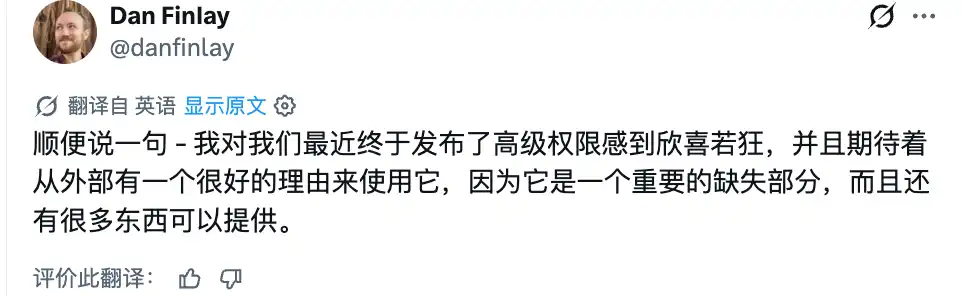
On the day Finlay left, MetaMask just launched a new feature called ERC-7715 for advanced permissions. He said he looked forward to experiencing it as a regular user in the future.

A product's creator becoming its ordinary user is probably the most朴实 (simple/unadorned) and quietest farewell in the crypto industry.

But for MetaMask, how many ordinary users will still click on that little fox every day next year? Are you still using it?

Related Questions

QWhy did Dan Finlay, the co-founder of MetaMask, leave Consensys?

ADan Finlay left Consensys due to professional burnout and a desire to spend more time with his family.

QHow does MetaMask's revenue compare to its competitor Phantom's revenue?

AAccording to data from whales.market, Phantom's annualized revenue is approximately $108 million, while MetaMask's is about $46 million, making Phantom's revenue more than double that of MetaMask.

QWhat is the significance of the timing of Finlay's departure in relation to Consensys's corporate plans?

AFinlay's departure coincides with Consensys's plans for an IPO, as the company has reportedly hired J.P. Morgan and Goldman Sachs as advisors with the goal of going public as soon as this year.

QWhy was MetaMask slow to support the Solana blockchain, and what was the consequence?

AMetaMask was slow to support Solana due to its identity as an Ethereum-native product and its close ties to the Ethereum ecosystem. This delay allowed competitors like Phantom, which launched on Solana first, to capture a significant share of the new user growth on that chain.

QWhat does the article suggest is the primary motivation behind Consensys's push for an IPO?

AThe article suggests that Consensys is pursuing an IPO to monetize MetaMask's strong brand recognition and narrative value while it is still high, even though the product's competitive edge and user growth are declining.

Related Reads

Xpeng and NIO Compete on Computing Power, Li Auto Shifts Architecture

On June 15, 2026, Li Auto unveiled details of its self-developed chip, Mahe M100, for its new L9 Livis model. CTO Xie Yan stated the goal was not just a faster chip, but a fundamentally different one, targeting the chip architecture itself. While competitors like NIO, Xpeng, and Huawei highlight TOPS (computing power) figures for their self-developed chips, Li Auto’s Mahe M100 focuses on redesigning the underlying architecture. It employs a "dynamic data flow architecture" to address memory bandwidth bottlenecks in large model inference, claiming up to 3x the effective computing power of Nvidia's Thor U for its specific workloads and a 40% reduction in latency. The chip's design was peer-reviewed and accepted at ISCA 2026. However, this performance is highly optimized for Li Auto's own VLA2.1 algorithm, meaning it may not generalize as well to other tasks. Li Auto aims to achieve full-stack in-house development with Mahe M100, covering chip, compiler, OS, AI algorithms, and domain controller—a level of vertical integration few competitors match. Beyond the chip, CEO Li Xiang introduced a new strategic narrative: the "embodied intelligent vehicle," defined as an integration of an EV, a professional driver, an AI computer, and a life assistant. This shifts competition from features like large screens to systemic AI capabilities. A key commitment was that Li Auto's Mahe VLA autonomous driving model will match Tesla's FSD V14 by Q4 2026, with specific OTA milestones set for July, September, and December. Financially, Li Auto faces pressure with declining revenue and vehicle gross margins since Q4 2025, while maintaining high R&D investment (approx. ¥12B in 2026, 50% AI-related). Its 2026 sales target is 550,000 vehicles, up from 406,000 in 2025. The new L9 Livis garnered over 10,000 pre-orders in two weeks. The effectiveness of these strategic moves—new products, OTAs, and the novel chip architecture—will begin to show in Q3 2026 financial results, with the year-end FSD V14 benchmark being the ultimate test.

marsbit35m ago

Xpeng and NIO Compete on Computing Power, Li Auto Shifts Architecture

marsbit35m ago

The Year of AI Applications: Saying 'Yes' While Ignoring Risks? A Comprehensive Open Source Log of Software Development's Journey

The Year of AI Applications: Blindly Saying "Yes" While Ignoring Risks? A Software Development Log Goes Fully Open Source. AI-generated code harbors risks hidden within seemingly correct programs, potentially leading to data leaks or asset loss. The open-source project "Narwhal AI Code Risks," from Peking University's Narwhal-Lab, compiles real-world cases, early warning signs, and typical risk pathways. Its goal is to help developers identify potential hazards early and avoid repeating past mistakes. In 2026, code is generated faster than ever but deployed with less scrutiny. The danger often lies not in glaring errors, but in code that appears normal—syntactically correct, passing all checks—yet introduces subtle but critical flaws like non-existent dependencies, excessive permissions, or exposed databases. A stark example is the Moonwell cbETH oracle incident. A configuration file error, where a cryptocurrency price was set to ~$1.12 instead of ~$2,200, slipped through 28 checks and a pull request signed by both AI (Claude, Copilot) and human developers. This "semantic deviation" resulted in a loss of $1.78 million. The risk is that AI can produce functionally valid code that is semantically wrong for the business context. As AI moves beyond simple code completion to modifying configurations, installing dependencies, and operating via autonomous agents, it traverses longer, less traceable paths within software engineering, blurring traditional boundaries and oversight points. The Narwhal AI Code Risks project structures information into three layers: `/cases` for documented real-world incidents, `/inferred` for early warning signals, and `/scenarios` for clear, generalized risk patterns not yet tied to specific events. This aims to create a lasting, public record to prevent collective amnesia about past AI-coding pitfalls. Risks are categorized into seven areas: Software Supply Chain (e.g., recommending fake packages), Code-Level Vulnerabilities (e.g., reintroducing path traversal bugs), Cloud & Infrastructure Misconfiguration (e.g., overly permissive settings), Agent Risks (from autonomous tool execution), Vertical Domain Risks (e.g., in finance, healthcare), Intellectual Property & Compliance issues, and Human Factors (like over-reliance on AI output). The project's core value is transforming isolated incidents into reusable knowledge—a foundational resource for developers to spot similar issues, for security researchers to build upon, for toolmakers to create detection rules, and for the community to contribute new findings. As AI integration accelerates, this open-source "logbook" serves as a crucial navigational aid, charting past errors to help future projects steer clear of the same traps.

marsbit36m ago

The Year of AI Applications: Saying 'Yes' While Ignoring Risks? A Comprehensive Open Source Log of Software Development's Journey

marsbit36m ago

The Foundation of SpaceX's Trillion-Dollar Valuation: Who is Dividing Up Musk's Annual Tens of Billions in Capital Expenditure?

SpaceX's trillion-dollar valuation is built on its three core businesses: Starlink (profitable, 60% of revenue), rockets (driving down launch costs), and AI (a major investment area). This creates a financial cycle: Starlink funds rocket development, which enables low-cost launches for AI hardware, generating future revenue. This cycle fuels annual capital expenditures of tens of billions, flowing to a vast supply chain. Suppliers are categorized by their replaceability. The first group includes irreplaceable players like NVIDIA (GPU/CUDA ecosystem), Eutelsat (critical radio spectrum), Filtronic (specialized amplifiers), Materion (strategic beryllium), and STMicroelectronics (antenna chips). The second group consists of hard-to-replace suppliers due to high switching costs, such as Honeywell (flight control), Carpenter Technology (specialty alloys), Hexcel (carbon fiber), Broadcom (data exchange), and Linde (industrial gases). The third group comprises high-volume, cost-critical suppliers for mass-produced items like Starlink terminals. Key names include Wistron NeWeb (primary manufacturer) and several A-share companies like Shenzhen Sunway (connectors), Pies New Materials (forgings), Western Superconducting (alloys), and Yingliu (castings). Other niche players include Trimble (timing), Astronics (power distribution), and CTS (thermal management). The article argues that investing in these suppliers, rather than SpaceX stock directly, offers an alternative opportunity. The rationale is threefold: procurement is just beginning to scale, SpaceX's IPO brings new transparency to its supply chain, and the situation mirrors early stages of past "super terminal" ecosystems like Apple or Tesla. While risks exist (commodity cycles, geopolitical factors, technology shifts), the core thesis is that SpaceX's massive, ongoing procurement will translate into reliable revenue for its key suppliers, regardless of its own stock price volatility.

marsbit1h ago

The Foundation of SpaceX's Trillion-Dollar Valuation: Who is Dividing Up Musk's Annual Tens of Billions in Capital Expenditure?

marsbit1h ago

SpaceX's Trillion-Dollar Valuation Base: Who's Sharing in Musk's Annual Tens of Billions in Capital Expenditure?

**Title: The Foundation of SpaceX's Trillion-Dollar Valuation: Who Benefits from Musk's Annual $100 Billion Capital Expenditure?** This article argues that investors seeking to benefit from SpaceX's growth might find greater opportunities in its supply chain rather than directly investing in the company itself, drawing parallels to historical successes with Apple, Tesla, and NVIDIA suppliers. **SpaceX's Business Model & Cash Flow:** SpaceX generates revenue from three main areas: 1. **Starlink:** Its profitable core, earning $11.3B in 2023 (60% of revenue), funding other ventures. 2. **Rockets (Falcon/Starship):** Requires $3B+ in annual R&D but achieves the world's lowest launch costs. 3. **AI:** Currently unprofitable (-$6B+ in 2023), investing heavily in ground-based supercomputers (220,000 GPUs) and future orbital data centers. The cycle is: Starlink profits → fund cheaper rockets → low-cost launches deploy AI hardware → AI compute rentals generate future revenue. This cycle drives annual procurement spending of tens of billions of dollars. **The Supply Chain Beneficiaries:** Suppliers are categorized by their replaceability: **1. Nearly Irreplaceable (High Barriers to Entry):** * **NVIDIA:** Powers the Colossus supercomputer; its CUDA ecosystem creates immense switching costs. * **Eutelsat (SATS):** Controls critical radio spectrum for satellite communications; holds a ~3% stake in SpaceX. * **Filtronic (FTC):** Supplies millimeter-wave signal amplifiers for Starlink satellites; SpaceX constitutes 83% of its revenue. * **Materion (MTRN):** Global leader in beryllium production, a strategic material used in Starship structures. * **STMicroelectronics (STM):** Supplies phased-array antenna chips for Starlink satellites. **2. Replaceable, but Switching Cost is Prohibitively High:** * **Honeywell (HON):** Provides flight control and inertial navigation systems with decades of certification. * **Carpenter Technology (CRS):** Manufactures ultra-pure specialty steel alloys for Raptor engines. * **Hexcel (HXL):** Supplies custom carbon fiber composites developed over a decade with SpaceX. * **Broadcom (AVGO):** Manages high-speed data switching. * **Linde Group:** Supplies industrial gases (liquid oxygen/nitrogen) from facilities built near SpaceX launch sites. **3. High-Volume, Cost-Critical Manufacturing:** Focuses on mass-producing components like Starlink user terminals (target: 30 million units). * **Key Players:** Wistron NeWeb (6285, primary terminal manufacturer), several Chinese A-share companies (e.g., Sunway Communication, PAX New Materials, Western Metal Materials, Yingliu Co.), and smaller US firms like Trimble (TRMB, timing systems). **Why Now?** Three factors make the supply chain opportunity timely: 1. **Volume Ramp-Up:** SpaceX plans 100 launches in 2026, aims for 30 million Starlink terminals, and will deploy AI data centers, meaning procurement will accelerate. 2. **Increased Transparency:** The IPO provides public financial data, allowing investors to track supplier order growth. 3. **Historical Precedent:** The current phase is likened to Tesla's early mass-production stage (circa 2018), suggesting a long growth runway for suppliers. **Conclusion:** The article posits that while investing in SpaceX stock is betting on Elon Musk's ambitious vision at a high valuation, investing in its established suppliers is a bet on the tangible, recurring revenue from its massive procurement budget, which is largely decoupled from day-to-day stock price volatility.

链捕手1h ago

SpaceX's Trillion-Dollar Valuation Base: Who's Sharing in Musk's Annual Tens of Billions in Capital Expenditure?

链捕手1h ago

Trading

Spot
Futures
活动图片