"119 to 176 Dollars": Behind SpaceX's Listing, MSX Once Again Successfully Executes the Pre-IPO Closed Loop

Odaily星球日报Published on 2026-06-13Last updated on 2026-06-13

Abstract

Following May's 300% gain on Cerebras, MSX delivered another outstanding performance during SpaceX's listing night. On June 12, SpaceX (SPCX) launched on Nasdaq, reaching a high of $176. This marked the successful culmination of MSX's Pre-IPO project launched in March, where users subscribed at $119, achieving gains of approximately 40-48%. This event validated MSX's complete Pre-IPO mechanism, a crucial advantage in a market where access to top-tier private company equity is typically limited to institutions. MSX's model provides a full cycle for users: subscription (at $119 for SpaceX), real-time on-chain portfolio tracking, optional early redemption, seamless conversion to tradable spot assets (SPCX.M) upon IPO, and final settlement in stablecoins. This end-to-end process distinguishes MSX from platforms that faced settlement issues during the SpaceX IPO, highlighting that the core challenge of Pre-IPO is not just access, but a clear exit and conversion path post-listing. This success with SpaceX is MSX's second major Pre-IPO verification, following the Cerebras listing in May, which yielded ~300% returns for early participants. These back-to-back achievements demonstrate MSX's capability to source, structure, and deliver real assets through a replicable on-chain model. The true barrier for Pre-IPO products lies not in providing an entry point, but in ensuring reliable fulfillment from subscription through to post-IPO liquidity. MSX's proven闭环 (closed-loop) process addr...

Following a 300% return on Cerebras in May, MSX delivered its second 'perfect score' on SpaceX's listing night.

Did you partake in this $2 trillion IPO feast for SpaceX?

In the late hours of June 12th, Beijing time, as the largest IPO in history, SpaceX (SPCX) officially debuted on the NASDAQ and began trading. Its stock price touched a high of $176 intraday, with its market cap once surpassing $2.3 trillion.

For MSX Maiton, SpaceX's market listing also signified a crucial fulfillment point for its SpaceX Pre-IPO project launched in March.

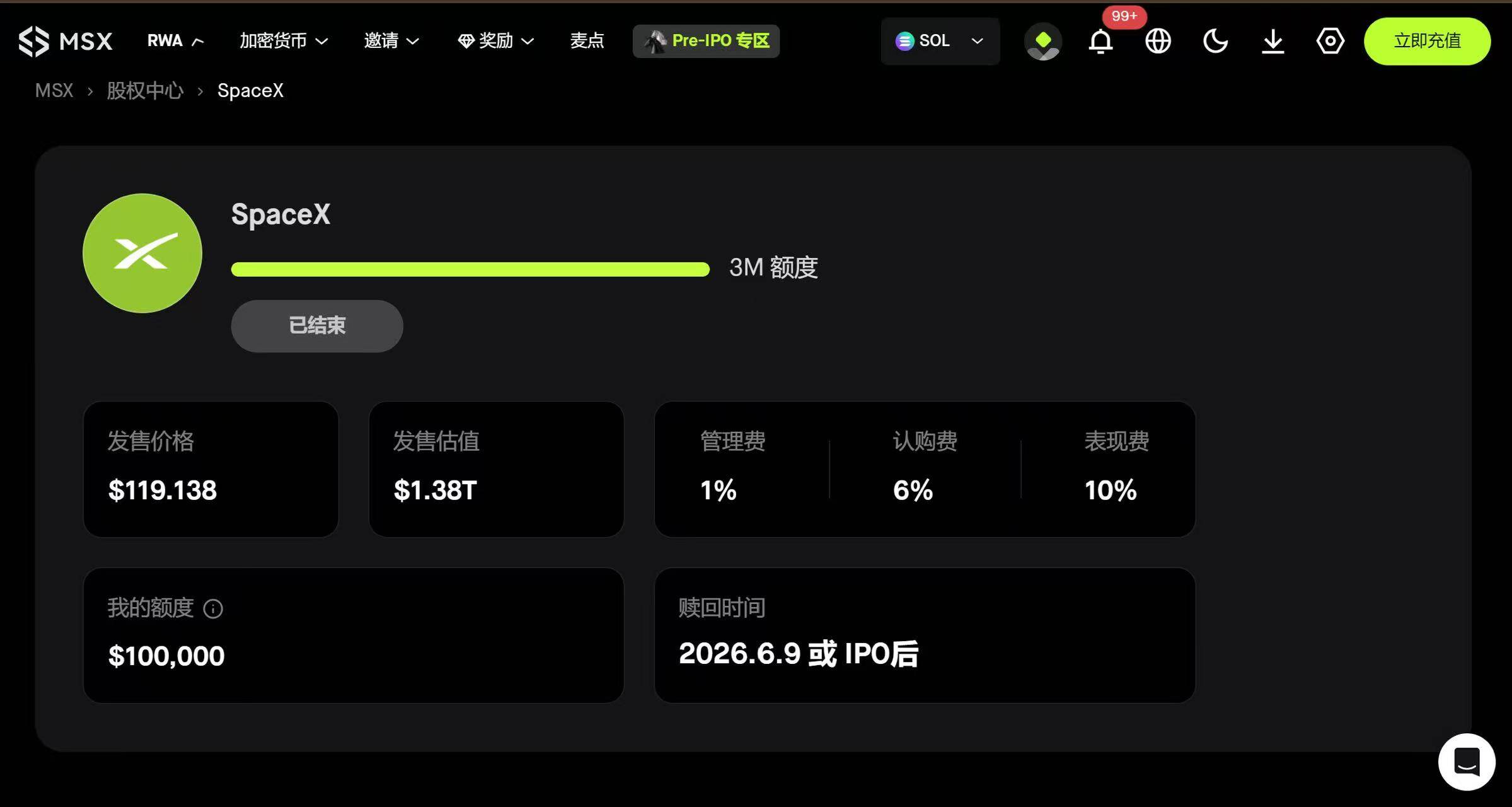
In early March this year, MSX opened access to participate in the SpaceX Pre-IPO, with a subscription price of 119 U (post-stock split adjustment, same below), corresponding to an offering valuation of approximately $1.38 trillion. With SpaceX's listing, MSX users were able to complete the full journey—from participating in a high-quality private market asset to welcoming public market pricing—in just 3 months.

Calculated based on SPCX.M's closing price of $166.85 after the first day of trading, this represents an increase of about 40% compared to MSX's early subscription price of 119 U; if calculated based on the intraday high of $176, the gain approaches 48%.

This marks another complete validation of the MSX Pre-IPO product model, following Cerebras in May.
I. Three Months: From Subscription at 119 U to Listing Liquidation

As is well known, for a long time, equity opportunities in top-tier unlisted companies have primarily been concentrated in the hands of institutional investors, private equity funds, and a small number of high-net-worth individuals. Ordinary investors could only participate at secondary market prices after a company completed its IPO.

However, the truly imaginative growth phase often occurs before a company goes public, which is the core value proposition of Pre-IPO products.

Precisely because of this, as early as March 2nd, MSX Maiton pioneered the launch of a Pre-IPO section for ordinary users. Subsequently, we've seen an increasing number of similar products emerge in the market, bringing one question to the forefront.

The true value of Pre-IPO is not merely about allowing users to see a hot target earlier, but rather whether it can complete the full closed loop from subscription, holding, listing, trading, to liquidation after the target officially lists.

The execution of MSX Maiton's SpaceX project is a concentrated embodiment of this mechanism:

- Subscription: On March 2nd, users could subscribe to SpaceX's Pre-IPO shares on the MSX platform at 119 U, with assets recorded on-chain in token form;

- Holding: From subscription until the IPO listing, users could view their holding status in real-time on the MSX platform, with asset visibility throughout the process;

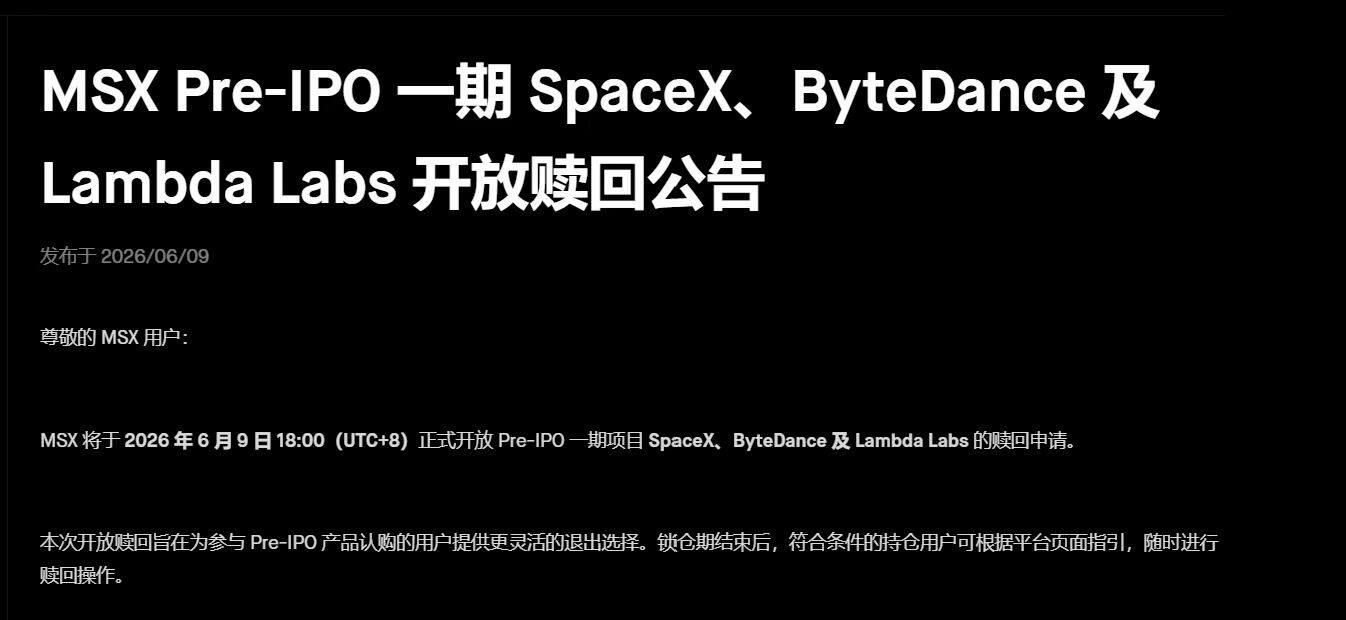
- Redemption Opening: On June 9th, redemption applications officially opened for the first phase of Pre-IPO projects—SpaceX, ByteDance, and Lambda Labs—providing more flexible exit options for users who participated in the Pre-IPO product subscription;

- Official Listing: On June 12th, SpaceX listed on NASDAQ, opening with a significant surge and closing after-hours at 166.85 U, approximately 40% higher than MSX's subscription price;

- Spot Trading: MSX simultaneously launched SPCX.M spot trading. Tokens held by Pre-IPO users were directly converted into tradable spot assets, allowing immediate order placement and sale without waiting for lock-up period expiration;

- Liquidation Settlement: Proceeds from sales were settled in stablecoin, completing the capital closed loop;

Subscription, holding, redemption, listing, spot trading, liquidation—six interconnected steps, none can be omitted.
The value of this linkage was precisely validated in reverse during this listing round.

This SpaceX listing served as a concentrated stress test for the tokenized Pre-IPO sector. As some platforms' dependent third-party tokenized quota delivery channels failed to obtain SpaceX quotas during the settlement phase, multiple platforms refunded part or all of the subscription funds to users around the time of the listing.

Therefore, the smooth progression of the SpaceX project signifies that MSX Pre-IPO is not simply offering a 'conceptual share'. Instead, it has established a complete, executable closed-loop mechanism around subscription, holding, redemption, listing, spot trading, and stablecoin settlement.

For users, this point is more critical than short-term price appreciation alone, because the core challenge of Pre-IPO products has never been just about accessibility to purchase, but rather about having a clear path for asset conversion and exit after the target company lists.

II. Another 'Perfect Score' Delivered by MSX Maiton

In fact, the successful execution of SpaceX is also the second key report card handed in by MSX Pre-IPO, following Cerebras.

To understand the weight of this report card, we need to rewind time by one month.

On May 14th, 2026, the 'NVIDIA challenger' Cerebras (CBRS) listed on NASDAQ with an issue price of $185. It opened with its price nearly doubling and closed up about 68%. Beyond the public market, MSX users who participated earlier reaped an even more striking result—approximately 300% in two months.

As mentioned earlier, as early as March 2nd, MSX Maiton pioneered the launch of Pre-IPO products within the industry. The first phase included four hot targets: Cerebras, SpaceX, ByteDance, and Lambda Labs. Among them, users participated in the subscription of CBRS Pre-IPO shares at a price of 100.35 U.

Following Cerebras' NASDAQ listing on May 14th, the MSX platform also launched CBRS.M spot trading on the same day. Assets held by Pre-IPO users thus gained a subsequent trading and exit path. Calculated based on the first-day listing high, the comprehensive return rate for participating users once exceeded 300%.

The nearly 300% in May was the first report card for on-chain Pre-IPO; SpaceX in June is the second.

These two consecutive fulfillments further demonstrate that MSX Pre-IPO is not reliant on the occasional performance of a single project. Instead, it is consistently building a replicable and verifiable on-chain participation mechanism around global, high-quality primary assets.

III. The Real Threshold for Pre-IPO: From 'Entry' to 'Fulfillment'

From Cerebras to SpaceX, the consecutive fulfillment of MSX's Pre-IPO products is reshaping the market's understanding of the value of on-chain primary asset entry points.

Over the past three months, since MSX Maiton launched its Pre-IPO product in early March, almost all major trading platforms have begun to lay out plans around hot non-listed companies. While the implementation logic of these products varies, they essentially aim to meet user demand for an 'early entry point to quality assets'.

However, judging from actual execution, Pre-IPO is far from being as simple as 'providing a subscription entry point'. What truly tests a platform's capability is whether it can continuously screen high-quality targets with long-term value and clear listing prospects, obtain genuine and effective asset quotas, design clear and transparent participation rules, and, after the target officially lists, complete the衔接 (connection) of pricing, conversion, trading, and settlement.

The successive execution of Cerebras and SpaceX within two months is a concentrated test of this series of capabilities.

This is also a key distinction between Pre-IPO products and mere synthetic assets or price speculation—they can provide users with a clear, executable path when the target lists, converts, or is redeemed.

For users, while a low-barrier entry point is undoubtedly important, the ability to complete the closed loop from subscription to exit is what truly determines the quality of a Pre-IPO product.

As the global capital market enters a new cycle of listings for quality tech assets, Pre-IPO is poised to become one of the important entry points for Web3 users to participate in the growth of global companies.

Following another success with SpaceX, MSX Maiton's Pre-IPO target pipeline continues to expand, focusing on screening high-quality primary assets in high-certainty sectors such as AI and frontier technology. Simultaneously, it will continue to refine aspects like asset authenticity, rule transparency, user rights protection, and post-listing衔接 mechanisms. This enables on-chain users to participate early in the growth of the world's most imaginative companies, beyond the traditional primary market.

Empowering users to access global quality assets is precisely the初衷 (original intention) behind MSX Maiton's continuous improvement of product systems like tokenized US stocks and Pre-IPO.


Related Questions

QWhat is the core value of MSX's Pre-IPO product as demonstrated in the SpaceX listing?

AThe core value of MSX's Pre-IPO product is providing a complete, executable closed-loop mechanism for users, from subscription, holding, redemption, IPO listing, spot trading, to final settlement in stablecoins. It's not just about early access, but about having a clear path for asset conversion and exit post-listing.

QAccording to the article, what was the approximate percentage gain for users who participated in MSX's SpaceX Pre-IPO offering at the opening price?

ABased on the closing price of $166.85 on the first day, users who participated in MSX's SpaceX Pre-IPO at $119 gained approximately 40%. Based on the intraday high of $176, the gain was close to 48%.

QWhich other company's Pre-IPO offering was mentioned as a successful precedent for MSX's model prior to SpaceX?

ACerebras (CBRS) was mentioned as a successful precedent. MSX users who participated in its Pre-IPO offering at $100.35 saw potential returns exceeding 300% based on the stock's performance at its IPO debut on May 14th, 2026.

QWhat does the article identify as the real challenge or threshold for Pre-IPO products, beyond simply providing access?

AThe article identifies the real challenge as ensuring the platform can successfully manage the entire lifecycle from 'entrance to realization.' This includes securing real asset quotas, designing transparent rules, and most crucially, completing the pricing, conversion, trading, and settlement process after the company goes public.

QWhat areas or sectors will MSX reportedly focus on for future Pre-IPO asset selection?

AMSX plans to continue expanding its Pre-IPO asset reserve by focusing on high-certainty sectors such as Artificial Intelligence (AI) and frontier technology, selecting premium private companies from these fields.

Related Reads

pump.fun's New Feature Brings 'Black Mirror' Into Reality

The article begins by recounting a dark fictional story from *Black Mirror* (Season 7, Episode 1 "Common People"), where a man is forced to perform humiliating tasks online to pay for his wife's life-sustaining medical subscription. It then draws a parallel to a new real-world feature on the crypto platform pump.fun called "Pump.fun Go," which allows users to post and complete paid bounty tasks. This feature gained mainstream attention, often negatively, through extreme examples. A prominent case involved a bounty of 40 SOL (~$2,600) offered to permanently tattoo "$bountywork" on one's forehead. An Indian man completed the task, stating the money "changed his life," and later earned significantly more from a related meme coin. Another bounty paid 200 SOL (~$14,000) for a "bounty.fun" forehead tattoo, with the participant simply stating, "We need the money." The article highlights how this system can amplify darkness, citing the dev behind $Bountywork who spent thousands on bounties for attention-grabbing stunts like eating bugs or drinking hot sauce for small sums. It compares this to past tragic live-streaming incidents where people harmed themselves for money, noting regulation cannot stop those in desperate need. However, it also points to positive, altruistic bounties that have emerged, such as organizing anti-work rallies in New York, performing random acts of kindness for strangers, organizing community food drives, or even helping an elderly person cross the street. The piece concludes by acknowledging the platform reflects both the dark and light sides of human nature when actions are given a price, hoping for more of the latter.

marsbit4m ago

pump.fun's New Feature Brings 'Black Mirror' Into Reality

marsbit4m ago

As the US and Japan Hike Interest Rates, Which Asset Class is Most at Risk?

This week, global markets face two major events: the Bank of Japan's likely interest rate hike and the US Federal Reserve's FOMC meeting. For risk assets, it is a pivotal and volatile week. In the US, expectations for rate cuts have faded dramatically. May's higher-than-expected CPI and resilient jobs data have shifted the Fed's focus from potential cuts to the possibility of future hikes. New Fed Chair Wash is unlikely to raise rates at this meeting, but any hawkish shift in communication, the dot plot, or the policy statement could lead markets to price in tighter policy, pushing up short-term Treasury yields and strengthening the dollar. High-valuation growth stocks, AI-related assets, and small-cap stocks reliant on cheap funding are most vulnerable to rising rates. In Japan, a 25 basis point hike is almost fully priced in (98.3% probability), which would bring the policy rate to 1%, its highest since 1995. The concern is not the hike itself, but its potential to unwind the massive "carry trade," where investors borrowed low-yielding yen to invest globally. Historically, Japan's rate hikes have coincided with global market stress (2000, 2007, 2024). While this well-telegraphed hike may be digested smoothly, two key factors increase uncertainty: 1) Governor Ueda's absence due to illness, putting communication in the hands of less-familiar deputies, and 2) the Fed meeting occurring just days later, creating potential for a compounded market reaction if both central banks sound hawkish. Asset implications: * **Bonds:** US short-term yields sensitive to Fed signals. Japan's rate hike could pressure its massive US Treasury holdings. * **Currencies:** Dollar likely supported by Fed; Yen's reaction hinges on BoJ's forward guidance. * **Equities:** US growth stocks, small-caps most at risk. Japanese stocks face pressure from a stronger yen. * **Crypto:** Assets like Bitcoin face headwinds from higher rates and tighter liquidity; high-beta altcoins are even more vulnerable. The convergence of these two central bank meetings amplifies market volatility risks, with potential spillovers across asset classes globally.

marsbit9m ago

As the US and Japan Hike Interest Rates, Which Asset Class is Most at Risk?

marsbit9m ago

Data Decrypts the BTC Cycle: Three Major Bottom Signals Illuminate Simultaneously, Q4 Could Be a Crucial Turning Point Window?

"Decoding the Bitcoin Cycle: Three Bottom Signals Flash Simultaneously, Is Q4 the Key Turning Point?" The article analyzes Bitcoin's current market position, comparing it to historical cycles. BTC has corrected over 52% from its October 2025 peak of $126,198 to around $59,100 in June 2026. While significant, this drawdown is milder than the 77-86% declines seen in past bear markets. The analysis is framed within Bitcoin's four-year halving cycle. Past cycles show a pattern: prices peak 12-18 months post-halving, bottom 12-14 months after the peak, with lows typically occurring roughly 17 months before the next halving. Following the April 2024 halving and the October 2025 peak, this pattern suggests a potential bottoming window around Q4 2026, ahead of the expected 2028 halving. Three key on-chain metrics are signaling undervaluation: The MVRV Z-Score has dropped near 0.27, approaching historic bottom zones. The market price is only about 9% above the network's average realized price of ~$53,600, a rare low premium. Bitcoin's price recently touched its 200-week moving average (~$62,200), a level that aligned with bottoms in 2015, 2018, and 2020. While US spot Bitcoin ETFs saw record outflows in May/June 2026, indicating retail panic, whale addresses (holding 100+ BTC) reached a yearly high. Entities like MicroStrategy resumed buying, and long-term holders control a near-record 78% of the supply, suggesting accumulation. A major macro overhang was partially removed with a US-Iran ceasefire agreement in mid-June 2026, which eased oil prices and triggered a sharp BTC rally. However, persistent inflation means high-interest rates remain a constraint. The conclusion notes that genuine investment opportunities often arise when confidence is lowest, amidst narratives that "this time is different." While not guaranteeing an immediate bottom, the confluence of cycle timing, undervaluation signals, and shifting macro risks suggests late 2026 may be a critical period for reassessing risk/reward and patient accumulation for long-term believers.

marsbit9m ago

Data Decrypts the BTC Cycle: Three Major Bottom Signals Illuminate Simultaneously, Q4 Could Be a Crucial Turning Point Window?

marsbit9m ago

Trading

Spot
Futures

Hot Articles

Discussions

Welcome to the HTX Community. Here, you can stay informed about the latest platform developments and gain access to professional market insights. Users' opinions on the price of S (S) are presented below.

活动图片